
You can prep a home perfectly — fresh paint, the right furniture, art hung at the right height — and still have it photograph cold, flat, and vaguely unwelcoming. Nine times out of ten, it isn't the furniture or the paint color.
It's the bulbs.
And it's usually not one bad bulb. It's five different bulbs, bought at five different times, in five different colors, all burning in the same room.
Three numbers, three different jobs
The biggest source of confusion in the bulb aisle is that three unrelated numbers all get treated as "brightness." They aren't.
Kelvin (K) measures the color temperature of the light — how warm or cool it looks.
Lumen measure the brightness of the light — how much light actually comes out.
Watts measure the energy the bulb uses — which, with LEDs, tells you almost nothing about how bright it is.
That last one trips up nearly everyone. Under old incandescent bulbs, watts were a decent stand-in for brightness. With LEDs they aren't — which is why packaging now says things like "85W equivalent." Read the equivalent, not the actual wattage.
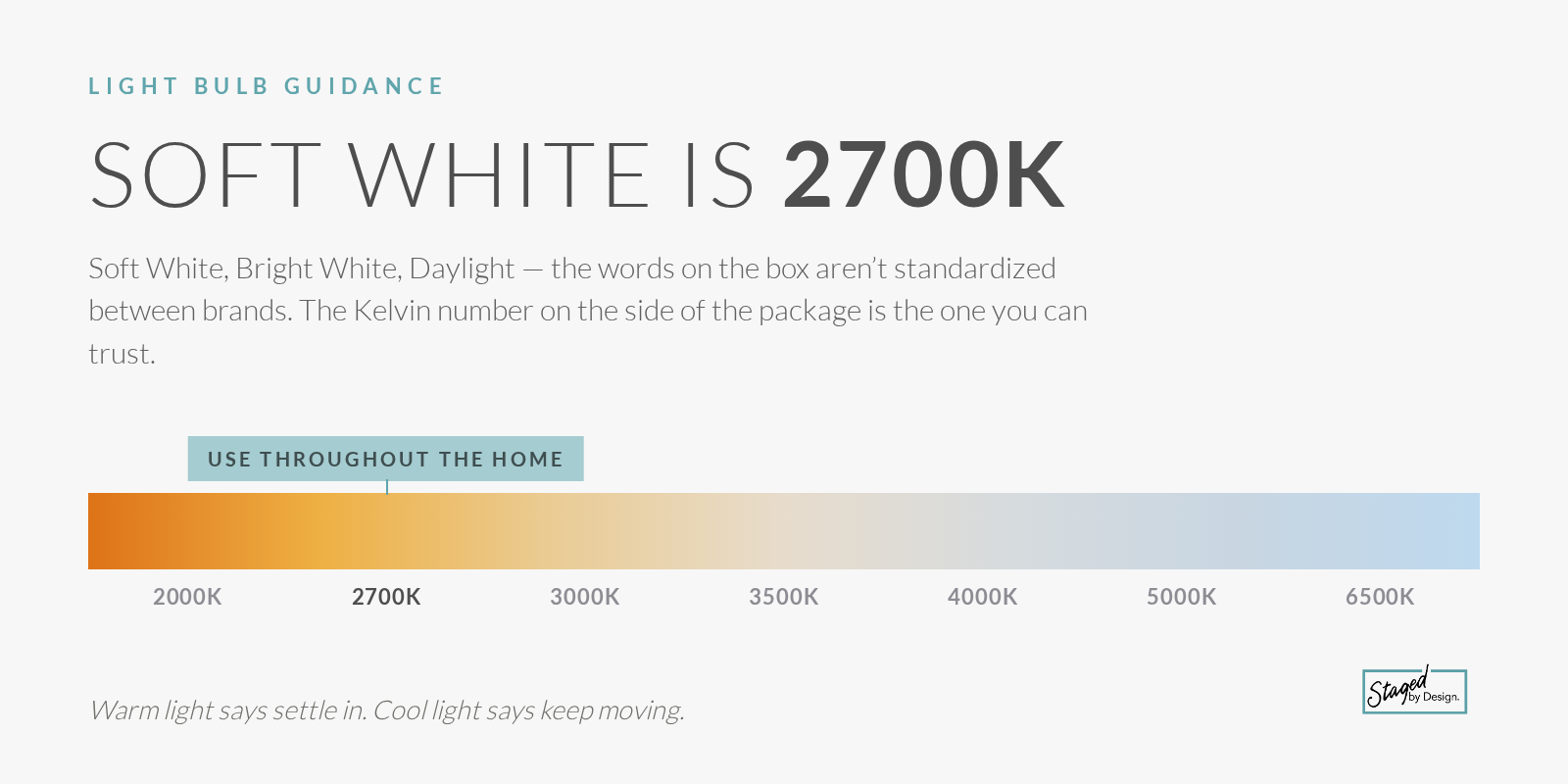
Also, the words on the front of the box — Soft White, Bright White, Daylight — are marketing terms that are not standardized between brands. One company's "Bright White" is another's "Cool White." The number you can trust is the Kelvin figure on the side of the package.
The Kelvin scale, end to end
Low Kelvin = warm and golden. High Kelvin = cool and blue.
The Kelvin scale, end to end
Low Kelvin = warm and golden. High Kelvin = cool and blue.
2000K — Deep amber, firelight. Best for: Accent only — too dim-feeling for a room
2700K — Soft White — the classic incandescent glow: warm, golden, flattering. Best for: the whole home
3000K — slightly crisper, still warm. Best for: acceptable, but don't mix with 2700K
3500K — neutral white, no yellow or blue. Best for: utility spaces
4000K — cool, clean, "office". Best for: garage, workshop
5000K — crisp blue-white. Best for: task work only
6500K — midday sun, strongly blue. Best for: almost never in a living space
Soft White sits at 2700K. That's the number to remember. It's the color of the bulbs everyone grew up with, and it's a big part of why those rooms felt like home.
A note of balance: going too far the other way doesn't help either. Bulbs that are too warm and too dim make a room feel gloomy and small. The goal is warm and bright — low Kelvin, high lumens. If a room feels dark, add a lamp or more lumens. Don't reach for a cooler bulb
A note of balance: going too far the other way doesn't help either. Bulbs that are too warm and too dim make a room feel gloomy and small. The goal is warm and bright — low Kelvin, high lumen. If a room feels dark, add a lamp or more lumen. Don't reach for a cooler bulb.
The staging reason: your paint colors
Here's the part that matters most and gets talked about least.
Paint colors have undertones, and light temperature decides whether those undertones read true or turn on you. Cool, high-Kelvin light pulls the warmth out of everything: creamy whites go gray or faintly green, warm greiges turn cold and purple-ish, wood floors and furniture lose their glow. Homeowners spend weeks agonizing over a paint color, then install 5000K bulbs and wonder why the walls look nothing like the sample.
Using the correct hue makes your paint read as true as possible — no unwanted undertones, no surprises in the listing photos.
What cool light does to a person
This is where it stops being a matter of taste. Blue-enriched, high-Kelvin light doesn't just look different — the body reads it as information.
Specialized cells in the retina are most sensitive to short-wavelength blue light, right around 460–480 nanometers — exactly the range high-Kelvin bulbs are loaded with. Those cells don't feed the vision system; they feed the brain's master clock. Their job is to answer one question: is it daytime?
So when a buyer walks into a bedroom at 6 p.m. lit by 5000K bulbs, their body gets told it's noon.
The research is quite direct. In one controlled crossover trial, healthy adults exposed to 6500K light for two hours in the evening — at a dim 40 lux, no brighter than a bedside lamp — showed greater melatonin suppression and higher alertness than the same people under 2500K or 3000K light at identical brightness. Same amount of light. Different color. Different physiological response. Harvard Health makes the same point plainly: blue-shifted light at night pushes the body's clock out of sync, and sleep suffers.
And the part nobody talks about: how it feels
The alertness research has a flip side that matters more when you're selling a house.
Alert is not the same as comfortable. Studies comparing people under warm white (2700K), cool white (4000K), and daylight (6200K) consistently find the cooler settings improve wakefulness and task speed — while preference and visual comfort run the other direction. People perform under cool light. They relax under warm light. Those are two different jobs, and a home on the market needs the second one.
There's a learned association at work too. Where has your buyer spent their life under 4000–5000K light? Offices. Hospital hallways. Big-box stores. Dentist waiting rooms. That association walks into your living room with them, and it arrives as a feeling rather than a thought — slightly clinical, a little exposed, not somewhere you'd curl up on a Sunday.
Buyers seldom say "the color temperature is wrong." They say the house felt cold, or sterile, or that it just didn't feel right — and then they leave.
Warm light is also kinder to everything in the room. It makes wood glow, keeps whites soft instead of icy, and — not incidentally — flatters every face at your open house.
Our recommendations
Throughout the home: 85W-equivalent Soft White LED bulbs. Use the same wattage and the same color temperature in every fixture within a space — consistency matters as much as the color itself. And always check the bulb base before you buy; the wrong base is the most common wasted trip to the store.
Recessed lighting: same rule — 85W equivalent, Soft White, matched across the room. For integrated LED disc or wafer lights, which often have a small switch to select color temperature, make sure every fixture is set the same. We recommend the Soft White setting.
Individual lamps and vanity fixtures: use the highest wattage the fixture allows. Table lamps, floor lamps, and bathroom vanities are usually doing the real work of lighting a room, and a fixture running below its capacity reads as dim and gloomy in person and in photos. Every fixture has a maximum wattage rating printed on the socket or the harp — go up to it, not past it, and keep the color at Soft White.
Clear glass fixtures — chandeliers, pendants, flush mounts, outdoor lanterns: use Soft White Edison bulbs. When the bulb is visible, its color and shape are part of the fixture. Choose the highest wattage or LED equivalent your fixture supports, and verify the base before purchasing.
Before your photos: a ten-minute walkthrough
Walk the house at dusk with every lamp and fixture on. Mismatched bulbs are invisible in daylight and glaringly obvious at night. This is the single most useful ten minutes you'll spend.
Check every socket in multi-bulb fixtures — vanities, chandeliers, ceiling fans. A single stray Daylight bulb in a row of five will color the entire photo.
Replace whole rooms at once, not one burnt-out bulb at a time. Piecemeal replacement is exactly how the mismatch happens.
Don't fix dim with cool. Add lumens or add a lamp; keep the Kelvin at 2700K.
Do it before the photographer arrives. Mismatched color temperatures are the hardest thing to correct in editing — and listing photos are where most buyers meet your home first.
The short version
Buyers decide how they feel about a house long before they can explain why. Light temperature is one of the quietest, cheapest levers you have over that feeling — a box of matched Soft White bulbs costs a few dollars and takes an afternoon.
Warm light says settle in. Cool light says keep moving.
Make sure your home is saying the right one.
Leigh Newport is the Owner and Principal Designer at Staged by Design, where she has spent 20 years preparing homes for sale in NOVA and the surrounding areas. Questions about prepping your home? Contact her at info@staged-by-design.com. To schedule your Home Staging Consultation service, visit www.staged-by-design.com.